The construction industry in Indonesia is undergoing one of the most significant digital transformations in its history. Traditional workflows that once relied heavily on manual calculations, printed blueprints, limited field documentation, and in-person supervision are now shifting toward more automated and technology-supported systems. Among the most impactful technologies shaping this evolution is Augmented Reality (AR), delivered through powerful AR construction applications designed to improve the accuracy, speed, safety, and decision-making abilities of professionals on-site.
An AR construction app Indonesia contractors use today is more than just a digital viewer—it has become a practical tool that supports real-time information access, ensures alignment between planned models and field execution, and reduces miscommunication across project stakeholders. When combined with Building Information Modeling (BIM), AR allows digital building models to be visualized directly on-site and overlaid on real-world surroundings. This capability unlocks a new level of transparency and enables better control of each construction phase.
With solutions like BuildX, available at https://buildxapp.net/, AR technology becomes accessible not only to major enterprises but also to small and mid-sized contractors across Indonesia. The result is a more democratized, efficient, and modern construction environment that enables companies to compete at a higher level without needing expensive new hardware or large software investments.
In this article, we will explore the major benefits of AR construction apps for Indonesian contractors and how they directly impact on-site performance, project quality, operational productivity, and long-term business competitiveness.
AR Construction Apps Reduce Human Error and Improve Accuracy
In construction, accuracy is everything. A small measurement mistake during the early stages can lead to structural misalignment, additional material costs, and increased labor hours to correct the issue. Traditionally, many errors occur because site workers rely on printed drawings, hand sketches, incomplete information, or outdated documentation. Once a mistake is discovered, teams often must backtrack to identify where things went wrong, losing time and money in the process.
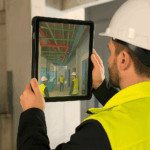
AR construction apps dramatically change this situation by allowing contractors to visualize BIM models on top of real physical locations in real time. Workers can stand in front of a wall, structure, or floor area and instantly compare the digital plan with what has already been constructed. This direct real-world overlay eliminates guesswork and ensures that decisions are made based on accurate and up-to-date information.
Furthermore, AR applications can guide workers through step-by-step installation instructions, ensuring that key components such as piping, electrical conduits, HVAC systems, or structural elements are placed exactly where they should be. For contractors in Indonesia managing multiple subcontractors, this becomes particularly valuable because it creates a single shared source of truth that prevents misunderstandings and conflicting interpretations.
By reducing errors early, contractors can maintain project alignment, preserve schedule integrity, avoid costly rework, and deliver higher-quality results to clients. Over time, this leads to stronger market credibility and more repeat business in a highly competitive construction sector.
Improved Communication and Collaboration On-Site
Effective communication has always been a challenge in construction. Field engineers, supervisors, architects, and project owners may each hold different versions of the same drawing, leading to confusion, outdated revisions, or incorrect instructions reaching workers on-site. This issue becomes even more difficult in Indonesia, where projects may be spread across multiple locations, and not all teams are equipped with shared digital systems.
An AR construction app Indonesia teams adopt helps centralize project communication by providing real-time access to synchronized BIM models and digital project data. All stakeholders—from designers to on-site supervisors—can view the same 3D representation of the project, ensuring consistent interpretation of design intent. Instead of flipping through paper documents or sending endless follow-up messages, decisions can be validated visually and instantly.
For example, if a contractor needs to clarify the location of a structural beam, they can simply open the AR app, point the device toward the installation area, and verify—through both spatial context and digital alignment—whether the placement will match the final intended structure. This visual method eliminates long explanations and provides immediate clarity for everyone involved.
Additionally, AR enables better collaboration during remote review sessions. An architect in Jakarta and a contractor in Surabaya can both observe the same digital model and discuss modifications without needing physical travel or site visits. This dramatically increases efficiency and accelerates decision-making cycles, which is essential for projects working under tight schedules.
Faster Project Execution and More Efficient Workflows
Time is one of the most valuable resources in construction, and delays can quickly escalate into significant financial losses. Delays may occur due to inefficient workflows, unclear instructions, blockages in decision-making, late approvals, or slow verification cycles. AR technology helps eliminate many of these bottlenecks by enabling real-time on-site validation and faster execution.
Tasks that traditionally required manual layout checks, additional paperwork, or separate field measurements can now be performed through AR visuals. Workers can move directly from instruction to execution with fewer steps and interruptions. This increases the pace of project delivery while maintaining—or even improving—the quality of the final result.
In addition, AR construction apps can store digital manuals, installation guidelines, and model annotations, ensuring workers never lose time searching for documents. If a supervisor identifies an issue on-site, they can mark the problem digitally through the AR interface, allowing other teams to immediately understand what needs correction. This improves coordination and helps eliminate unnecessary delays caused by unclear documentation.
When used consistently, AR also provides better understanding of project layouts, helping site workers visualize upcoming phases and prepare tools and materials in advance. The more predictable the workflow, the smoother the operations—and the less likely the project will fall behind schedule.
For Indonesian contractors competing in a price-sensitive market, faster project delivery increases productivity, improves profitability, and enables companies to take on more projects without stretching their operational capacity.
Enhanced Quality Assurance and Reporting
Maintaining consistent quality standards is one of the biggest challenges in construction. A beautifully designed BIM model does not guarantee flawless execution—quality depends heavily on how well the design is translated into actual site work. Traditional QA relies on manual inspection, checklist audits, and verbal reporting, which may be subjective or inconsistent across supervisors.
AR improves quality assurance by giving contractors precise visual comparisons between the as-planned and as-built environments. Using an AR construction app, a supervisor can immediately see whether critical installations match the model specifications and can detect deviations that might otherwise remain unnoticed until much later.
Moreover, the app makes documentation more accurate and efficient. Instead of filling out long written reports, contractors can capture annotated visual snapshots—complete with digital overlays—showing exactly what needs adjustment or what has already been completed satisfactorily. These visual records become valuable evidence of progress and help streamline communication with clients, designers, and regulatory authorities.
In the long run, robust documentation strengthens company professionalism, protects against disputes, and ensures that every project demonstrates consistent workmanship and compliance.
Lower Operational Costs and Higher Competitiveness
Cost control is one of the most critical priorities in the Indonesian construction market. Fuel prices, fluctuating material costs, and the need to manage multiple project sites can quickly stretch budgets. AR construction applications indirectly reduce operational costs by minimizing waste, improving oversight, and eliminating inefficiencies that drain financial resources.
Instead of waiting for experts to travel to sites, remote inspections can be performed using AR visualizations, allowing quick guidance without additional transportation expenses. Rework is minimized because errors are caught early. Workers are more productive because they do not waste time interpreting incomplete instructions. Documentation is faster, clearer, and more accurate, reducing administrative burdens.
Companies that use AR gain a significant competitive advantage. They can deliver projects faster, meet higher quality expectations, and demonstrate digital capabilities that modern clients increasingly value. As more Indonesian developers demand transparent reporting and precise execution, contractors who adopt digital tools like BuildX from https://buildxapp.net/ position themselves as modern, efficient, and forward-thinking partners.
Conclusion
The construction sector in Indonesia is rapidly evolving, and AR technology is playing a major role in this transformation. An AR construction app Indonesia contractors deploy brings measurable benefits: higher accuracy, faster project timelines, improved collaboration, stronger quality assurance, and reduced operational costs. Whether used at the planning stage, during installation, or for final inspections, AR empowers construction teams with real-time insights that simplify complex decisions and minimize miscommunications.
As the industry continues shifting toward BIM and digital workflows, AR will become an essential tool rather than a luxury. Contractors who adopt these tools early stand to gain a competitive edge and deliver higher value to clients. Platforms like BuildX, accessible at https://buildxapp.net/, make it practical for companies of all sizes to begin embracing modern construction technology today.
The future of Indonesian construction is digital, precise, and highly collaborative—and AR is one of the key innovations leading the way.