The construction industry is experiencing a major digital shift as new technologies transform how buildings are designed, executed, and handed over. Among the most significant innovations today are Building Information Modeling (BIM) and Augmented Reality (AR). While both technologies have existed separately for years, their integration is now unlocking new levels of speed, transparency, and efficiency across every stage of the project lifecycle. Instead of relying on traditional communication and outdated documentation, BIM AR integration allows construction teams to visualize models in real-world environments, collaborate in real time, and make faster, evidence-based decisions.
As project timelines become more demanding, contractors and consultants must find ways to deliver accurate work faster and with fewer revisions. This is where BIM AR becomes transformative. Through mobile devices, tablets, or specialized headsets, workers can bring digital 3D models onto job sites, compare planned designs with current progress, identify deviations instantly, and prevent costly rework. Platforms like BuildX, available at https://buildxapp.net/, support this transformation by offering accessible BIM AR capabilities that improve coordination and keep project teams aligned.
Below, we explore how combining BIM and AR speeds up project delivery, the problems it solves, and the practical advantages it brings to architects, engineers, project managers, contractors, and field personnel.
Why Construction Teams Need Faster and More Accurate Information Flow
Construction is a highly dynamic industry with countless moving parts. Every day on site involves progress updates, supply deliveries, subcontractor coordination, safety checks, design clarifications, and on-site problem solving. Traditionally, much of this information is communicated through emails, printed drawings, manual reporting, or face-to-face discussions. These methods often result in delays, data loss, or misunderstandings that can escalate into major project bottlenecks.
A missed design update may cause a contractor to install components based on outdated drawings. A problem discovered late may require demolition and rework. A misinterpreted specification may cause weeks of delay. These inefficiencies are some of the biggest contributors to budget overruns and schedule setbacks. Smart digital solutions allow construction teams to solve these problems not by working harder, but by working smarter. Real-time information eliminates the gap between design and execution. Workers no longer need to wait for meetings or site visits to understand design intent. Instead, they access the model immediately, check details visually, and proceed with confidence.
This shift dramatically reduces cognitive load and uncertainty. Instead of interpreting technical symbols and measurements from static 2D drawings, workers see digital overlays precisely where their work will happen. The result is improved accuracy, faster task completion, and clearer coordination. BIM AR is becoming indispensable not only for large-scale commercial projects, but also for residential development, infrastructure, and industrial construction where precision and speed are crucial.
How BIM Makes Construction Data More Intelligent
Before augmented reality is brought to the site, BIM serves as the foundation of information and design accuracy. BIM is more than a digital 3D model; it is a structured database containing spatial geometry, material specifications, installation instructions, maintenance requirements, and linked construction schedules. It brings together everything that architects, engineers, clients, and contractors need to understand the project and make informed decisions.
Unlike traditional CAD drawings, BIM is dynamic. When one element changes, the system automatically updates associated data. If a ceiling height changes, ductwork, piping, and lighting paths adjust. This prevents conflicts that otherwise would only be discovered during physical construction. BIM’s centralized database ensures all stakeholders work from the same version of the truth, reducing disputes and enhancing collaboration.
However, BIM alone is typically viewed on computers in the office. To fully benefit, teams need a way to connect this digital intelligence with on-site execution. This is where AR completes the picture. Integrating BIM with augmented reality creates a bridge between design and real-world conditions. Workers see building elements as they are intended to be installed—before they exist physically. This clarity accelerates construction, increases trust in the process, and minimizes guesswork on site.
Bringing AR onto the Job Site for Real-Time Decision Making
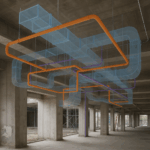
Once BIM data is available, AR brings it into the field in a way that is instantly understandable. Using smartphones, tablets, or wearable displays, contractors can superimpose 3D building models onto actual environments. Walls, structural elements, ducts, utilities, and equipment appear digitally on screen exactly where they should be installed.
Workers can walk through a site and check whether installed components match the planned model. If something is misaligned, the deviation becomes obvious instantly. Instead of waiting for an inspector to notice later or uncovering the issue after additional work has been completed, detection happens on the spot. This eliminates days or weeks of delay and prevents rework before it becomes expensive.
On larger projects, AR also speeds up communication. Instead of verbally describing a problem, workers capture visual evidence with AR annotations. Project managers receive the issue immediately, complete with context, model references, and location details. If a design clarification is needed, architects can issue updated instructions without having to visit the site. This tight feedback loop accelerates project delivery and keeps decision-making grounded in accurate information.
Improving Installation Accuracy and Reducing Rework
One of the most expensive issues in construction is rework. Many mistakes occur not because of carelessness, but because workers interpret 2D drawings differently from what designers intended. Traditional installation requires reading paper documents, translating them mentally into spatial understanding, and then executing them. For complex spaces like mechanical rooms, electrical corridors, or ceiling voids, this process is difficult and error-prone.
With BIM AR integration, that challenge disappears. Instead of interpreting drawings, installers see exactly where pipes, conduits, beams, panels, and equipment should be placed. The digital overlay ensures correct positioning, alignment, and spacing. This increases installation accuracy dramatically and reduces trial-and-error. Even new team members can perform tasks more confidently because the visual instruction is clear and unambiguous.
Additionally, any mismatches between design and field conditions are detected early. For example, if an unexpected obstruction exists in the real structure, workers identify the conflict immediately and escalate the issue before constructing around it. This proactive approach is a major departure from traditional problem solving, where issues might only surface after an inspector or later trade identifies the mistake.
Solutions like BuildX support these capabilities and make installation verification more reliable. By integrating BIM and AR tools, contractors can meet design intent faster, complete tasks with greater confidence, and prevent problems that would otherwise push deadlines back.
Enhancing Site Coordination and Multi-Trade Collaboration
Construction is rarely linear. Multiple trades often work in the same areas on overlapping timelines—electrical installations depend on structural progress, HVAC paths must accommodate beams and slabs, and finishing work requires prior clearance of hidden MEP systems. When coordination fails, conflicts arise, and the schedule suffers.
BIM AR integration improves this drastically by ensuring that every trade understands their space and responsibilities through visual reference. Foremen can walk through the site and see which areas are ready for installation, which zones require adjustments, and whether previous trades have completed their tasks correctly. Instead of relying on phone calls, shared folders, or hard-to-interpret markups, teams see the design in 3D exactly where the work is happening.
This clarity reduces waiting time, avoids space conflicts, and improves handovers. Multi-trade coordination meetings become more productive because participants are discussing real, visual data rather than abstract reports. Subcontractors gain confidence that the jobsite environment matches plans, and if something is behind schedule, affected teams know immediately.
Companies that use platforms like BuildX, accessible at https://buildxapp.net/, benefit from faster workflows, clearer communication, and fewer clashes between trades. By removing invisible obstacles in scheduling and coordination, BIM AR helps projects flow more smoothly from one stage to the next.
Strengthening Quality Assurance and Inspection
Quality assurance is essential to ensuring that the delivered building meets design intent and performance expectations. Inspectors traditionally walk the site with printed drawings, measuring equipment, and handwritten notes. This workflow is slow, prone to oversight, and sometimes difficult to verify later.
With BIM AR integration, inspection becomes faster, more consistent, and easier to document. Inspectors can compare built conditions directly against digital models. If components are missing, misaligned, or incorrectly installed, discrepancies become visually apparent. The system allows inspectors to record findings immediately with photographs, digital overlays, and comments, ensuring that documentation is complete and retrievable.
Instead of writing lengthy explanations, inspectors create visual reports that minimize ambiguity. Contractors understand issues more quickly and can respond without waiting for additional clarification. This accelerates corrective action and shortens inspection cycles. Leads can also track recurring issues, making it easier to identify training needs, supplier improvements, or workflow adjustments.
By transforming inspection from manual interpretation to digital comparison, BIM AR reduces human error and increases repeatability. On complex projects where accuracy is critical, this ensures that the final handover is smoother and that quality is demonstrated with verifiable evidence.
Shortening the Feedback Loop Between Office and Site
In traditional construction workflows, there is often a significant time gap between identifying a problem and communicating it to decision-makers. A field worker may notice a conflict but wait until the next meeting or end-of-day report to escalate it. Engineers may be unavailable to interpret the issue, delaying resolution even further.
BIM AR eliminates this delay by digitizing the feedback loop. Workers send annotated visual reports immediately, designers respond digitally, and instructions reach the field without waiting for formal review cycles. When teams can clarify issues instantly, work moves forward without unnecessary downtime.
Fast decision-making is one of the biggest reasons BIM AR improves project timelines. Instead of weeks of back-and-forth, problems are solved in minutes. Over the lifespan of a project, this can eliminate dozens of wasted working days and significantly improve delivery performance.
Conclusion
Integrating BIM and augmented reality represents a milestone in the evolution of modern construction management. Together, these technologies bridge the gap between digital design and physical execution, enabling faster decision-making, greater precision, and reduced project delays. Construction teams benefit from real-time visualization, improved trade coordination, accurate installation, and streamlined inspections that prevent problems before they escalate.
As expectations for speed and quality continue to rise, companies that rely solely on traditional workflows risk falling behind. BIM AR integration gives organizations a competitive advantage by empowering teams to work more efficiently, communicate clearly, and make informed decisions based on real-world conditions.
Platforms such as BuildX, available at https://buildxapp.net/, make this transformation accessible through mobile BIM visualization, augmented reality inspections, digital reporting, and collaborative communication tools. By embracing these capabilities today, contractors, engineers, and project owners can deliver projects faster, more accurately, and with greater confidence—establishing a new standard for the construction industry in the digital era.