
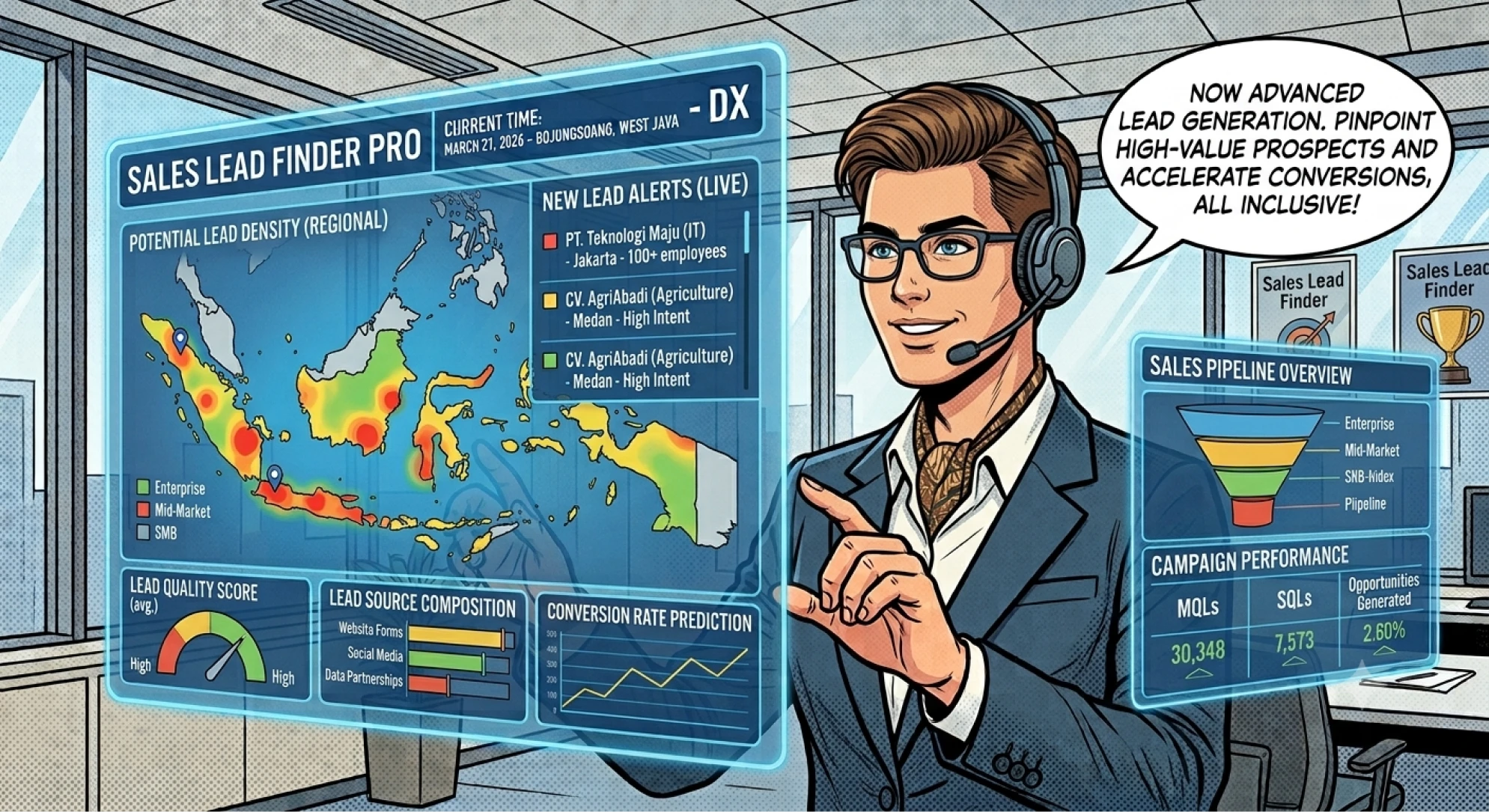
Finding potential business customers is only the first step in B2B sales. Sales teams also need to identify companies that match their target market, find relevant decision-makers, understand their needs, and determine which prospects deserve immediate attention. When employees perform these tasks manually, prospect research can consume hours that they could otherwise spend building relationships and closing deals.
AI lead generation helps businesses streamline this process by using artificial intelligence to support prospect discovery, data analysis, lead qualification, and sales prioritization. Instead of treating every contact as an equally valuable opportunity, businesses can use defined criteria to identify prospects that better match their ideal customer profile.
However, automation alone does not guarantee qualified leads. Poor data, vague targeting, and inaccurate assumptions can create large lists of irrelevant contacts. An effective strategy combines AI capabilities with clear sales criteria, reliable information, and human review.
This guide explains how AI lead generation works, how businesses can find and qualify B2B prospects automatically, and how to build a workflow that supports a more focused sales process.
What Is AI Lead Generation?
AI lead generation uses artificial intelligence to help businesses identify potential customers and assess their suitability for a product or service. Depending on the tools involved, the process may include company research, contact discovery, data enrichment, lead scoring, and personalized outreach preparation.
Traditional lead generation often relies on manual searches, spreadsheets, and repetitive research. A salesperson might visit dozens of company websites, check professional profiles, record business details, and compare each prospect against a target customer profile.
AI can help organize these activities and identify patterns across available data. For example, a software company targeting growing B2B service providers could use an AI-assisted workflow to identify businesses within a specific industry, collect relevant company information, and prioritize those that meet its sales criteria.
The process typically involves several connected activities:
- Prospect discovery: Identifying companies or individuals who may fit the target market.
- Data enrichment: Adding relevant business information to existing records.
- Lead qualification: Assessing whether a prospect meets defined criteria.
- Lead prioritization: Ranking prospects according to their potential fit and readiness.
- Sales preparation: Organizing insights that help representatives plan relevant conversations.
These activities do not always happen in one platform. Businesses should verify which capabilities their chosen software actually supports and whether it requires integrations with external data sources.
How AI Helps Businesses Find Better B2B Prospects
Effective prospecting begins with a clear understanding of the companies a business wants to reach. AI can then help organize research around that target market instead of generating an unfiltered list of contacts.
Define your ideal customer profile
An ideal customer profile (ICP) describes the type of company most likely to benefit from your product or service. It gives your prospecting workflow a consistent set of selection criteria.
For B2B sales, an ICP may include:
- Industry or business category
- Company size and employee count
- Geographic market
- Business model
- Operational challenges
- Existing technology or workflow requirements
- Relevant purchasing signals
For example, a company selling workflow automation software might prioritize service businesses with growing teams and repetitive administrative processes. A different business selling construction technology would need criteria relevant to contractors, estimators, or construction firms.
AI can help categorize prospects against these characteristics when reliable data is available. Nevertheless, businesses should define the criteria first rather than relying on an AI system to guess what makes a customer valuable.
Discover companies and relevant decision-makers
Once the target market is clear, prospect research can focus on finding organizations that match the ICP and identifying the roles involved in purchasing decisions.
A business selling marketing software, for instance, might target marketing agencies and look for relevant contacts in business development, marketing management, or company leadership.
Company fit and contact relevance are different questions. A company may match your target market, but the person you find might not influence the buying decision. A strong prospecting process evaluates both dimensions.
AI-assisted research can help organize available information, summarize company profiles, and identify potential role matches. However, teams should verify important details before using them for sales outreach.
Businesses exploring automated prospect discovery can review the BuildX AI Lead Finder to understand how the product may fit their lead generation workflow.
How to Qualify B2B Leads Automatically With AI
Finding prospects creates opportunities, but qualification determines where the sales team should focus its attention. A useful qualification process combines measurable criteria with evidence about the prospect’s potential needs.
Step 1: Establish qualification criteria
Start by defining the characteristics that distinguish a promising prospect from an unsuitable one. These criteria should reflect your product, sales cycle, and experience with previous customers.
For example, a B2B software provider might evaluate prospects using:
- Company fit: Does the organization operate in a target industry?
- Business need: Does it appear to have a problem the product can address?
- Decision-making relevance: Have you identified an appropriate contact?
- Buying readiness: Is there a credible indication of interest or a current requirement?
- Practical fit: Can the business serve the prospect’s location, requirements, and organizational needs?
Not every criterion deserves equal weight. A company might match the industry and size requirements but have no identifiable need for the product. Therefore, the qualification model should reflect actual sales priorities.
Step 2: Enrich and validate prospect data
AI-assisted workflows can help organize information such as company descriptions, industry categories, business websites, and professional roles.
However, data quality requires particular attention. Company information changes, employees change positions, and some records contain incomplete or outdated details.
Use reliable sources, check important fields, and record when information was last verified where possible. Avoid treating an AI-generated summary as proof that a company has a particular problem or purchasing intention.
Accurate data improves qualification; more data does not automatically mean better leads.
Step 3: Apply lead scoring
Lead scoring assigns points or categories based on how closely a prospect matches your qualification criteria.
For example, a hypothetical scoring model might assign points for target-industry fit, company size, a relevant decision-maker, and a verified business need. A prospect who meets several important criteria would receive a higher score than one with only a matching industry.
AI can support this process by classifying information and identifying patterns in prospect records. Still, sales teams should understand why the system ranks one lead above another.
Review the scoring model against real outcomes. If high-scoring prospects rarely progress to meetings or opportunities, adjust the criteria rather than assuming the model works.
Step 4: Route qualified leads to the right next step
After qualification, prospects can move into different workflows. High-priority leads may require prompt personal outreach, while less suitable prospects may need additional research or no immediate action.
For example:
- A prospect with strong company fit and a confirmed need may warrant direct sales follow-up.
- A prospect with incomplete information may need further research.
- A contact outside the target market may be excluded from the active pipeline.
Human review remains important when the system has limited evidence or when the potential opportunity requires a more nuanced assessment.
How to Build an Automated AI Lead Generation Workflow
A practical workflow connects prospect discovery with qualification and follow-up. The objective is not simply to collect contacts; it is to produce useful, organized opportunities for the sales team.
1. Define the target market and campaign objective
Choose a specific audience, such as logistics companies in a particular region or professional service firms within a defined size range. Then decide what the campaign should achieve, whether that means booking qualified meetings, identifying potential partners, or developing a new sales pipeline.
A narrow campaign makes it easier to evaluate whether the prospecting criteria work.
2. Find and organize relevant prospects
Use appropriate prospecting tools and permitted data sources to identify organizations that match your ICP. Keep company records, contact details, and qualification evidence organized so the sales team can review them efficiently.
Avoid collecting unnecessary personal information. Focus on business-relevant details that support a legitimate sales purpose.
3. Enrich records and assess fit
Add relevant information from reliable sources, check for duplicates, and apply the qualification rules. Separate verified facts from assumptions or AI-generated interpretations.
For instance, a company’s public description may indicate that it provides logistics services. That information supports industry classification, but it does not prove that the company currently needs a particular software product.
4. Connect qualification with follow-up
Once a lead meets the required criteria, assign a clear next action. Depending on your tools, this may involve exporting the record, updating a CRM, creating a task, or preparing a personalized outreach message.
Verify that your software supports the required integrations before designing the workflow around them. If a process still requires manual approval, make that step explicit.
5. Review results and refine targeting
Measure how many discovered prospects meet your qualification criteria, how many engage, and how many progress to sales opportunities. Use the results to refine the ICP, scoring rules, and data sources.
Businesses can explore the BuildX website to assess its available AI solutions and determine whether they align with their prospecting objectives.
How to Measure AI Lead Generation Performance
A large prospect list can create the appearance of progress without producing meaningful sales opportunities. To evaluate your workflow, track both lead quality and downstream business outcomes.
Important metrics include:
- Qualified lead rate: The percentage of identified prospects that meet your qualification criteria.
- Data accuracy rate: The proportion of sampled records with correct, relevant information.
- Positive response rate: The percentage of contacted prospects who respond positively.
- Meeting conversion rate: The proportion of contacted prospects who book a relevant meeting.
- Sales opportunity conversion: The percentage of qualified leads that progress into genuine opportunities.
- Cost per qualified lead: The cost of generating one lead that meets your defined standard.
- Time spent on prospect research: The amount of manual effort required to identify and qualify prospects.
Review these metrics together. For example, a workflow may generate many leads at low cost but produce few qualified meetings. In that case, improving targeting may deliver more value than increasing prospect volume.
Compare performance with your previous process and examine results by industry, campaign, and qualification category. This helps distinguish useful automation from activity that merely increases the number of records in your database.
Best Practices for Responsible and Effective AI Lead Generation
AI-assisted prospecting works best when businesses maintain control over targeting, data quality, and outreach practices.
Prioritize relevance over volume. A smaller list of suitable prospects can be more useful than a large collection of poorly matched contacts.
Verify important information. Check company details, contact roles, and qualification evidence before relying on them in sales decisions.
Make scoring explainable. Sales representatives should understand why a prospect receives a particular priority. Clear criteria make the process easier to audit and improve.
Personalize outreach using relevant evidence. Reference a prospect’s business context when you can verify it. Avoid inventing pain points or pretending to know a company’s internal challenges.
Respect privacy and communication rules. Use appropriate data sources, follow applicable data protection requirements, and honor opt-out requests. Automation should not become indiscriminate messaging.
Keep humans involved in important decisions. AI can organize research and support prioritization, but sales professionals should review uncertain cases and determine how to approach valuable opportunities.
Ultimately, AI lead generation is most useful when it connects relevant prospect discovery with evidence-based qualification. Businesses that define their target market, validate their data, and measure sales outcomes can create a more focused prospecting process without relying solely on manual research.
If your sales team spends too much time searching for companies and organizing contact lists, start by defining your ideal customer profile and identifying the most repetitive research tasks. Then explore the BuildX AI Lead Finder to evaluate whether its available capabilities fit your workflow.
Frequently Asked Questions
1. What is AI lead generation?
AI lead generation uses artificial intelligence to help businesses find potential customers, organize prospect information, assess lead quality, and prioritize sales opportunities.
2. Can AI automatically qualify B2B leads?
Yes. AI can support automated qualification by comparing available prospect information against predefined criteria. However, businesses should validate data and review uncertain or high-value prospects.
3. What is the difference between lead generation and lead qualification?
Lead generation identifies potential customers. Lead qualification evaluates whether those prospects fit the target market, have a relevant need, and merit further sales attention.
4. How can businesses improve the quality of AI-generated leads?
Define a clear ideal customer profile, use reliable data sources, verify important details, apply relevant scoring criteria, and evaluate results using qualified meetings and sales opportunities.
5. Is AI lead generation suitable for small B2B businesses?
Yes. Small businesses can use AI-assisted prospecting to organize research and reduce repetitive tasks. They should begin with a specific target market and expand automation based on measurable results.