Businesses today face a common challenge: doing more with limited resources while maintaining speed, quality, and customer satisfaction. As operations become increasingly complex, traditional workflows often struggle to keep up with growing demands. Teams spend valuable time on repetitive administrative tasks, fragmented communication, and manual reporting instead of focusing on strategic work.
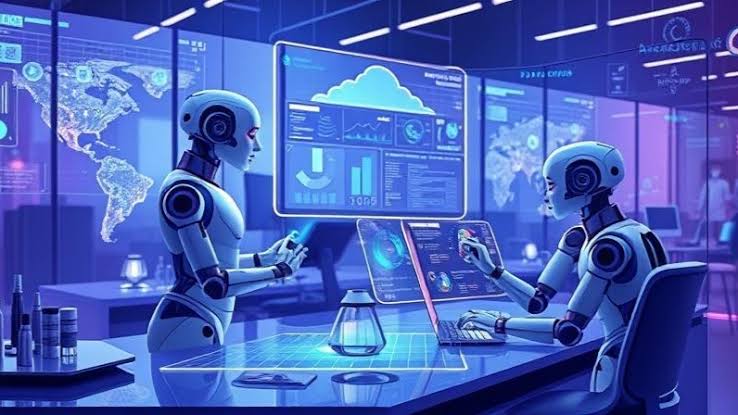
This is where an AI Digital Workforce is changing the way modern organizations operate. Rather than simply automating isolated tasks, an AI digital workforce functions as a team of intelligent digital employees that collaborate across departments, analyze business data, and support decision-making in real time.
Whether you’re running a construction company, startup, consulting firm, property development business, or agency, understanding how an AI digital workforce works can help you build more efficient and scalable operations.
What Is an AI Digital Workforce?
An AI Digital Workforce is a collection of AI-powered digital employees designed to perform specific business roles while working together as an integrated team. Unlike traditional automation tools that follow predefined rules, these intelligent agents can understand context, process information, generate insights, and recommend actions based on business data.
Instead of replacing employees, an AI digital workforce augments human capabilities by taking over repetitive, data-intensive, and time-consuming activities.
Typical responsibilities include:
- Monitoring business operations
- Managing project updates
- Supporting procurement activities
- Assisting finance and budgeting
- Improving customer service
- Handling HR administration
- Identifying sales opportunities
- Generating business reports
Organizations exploring the evolution of intelligent business operations can also learn more about AI Employees and how individual digital workers contribute to a larger AI-powered ecosystem.
Why Modern Companies Are Investing in an AI Digital Workforce
Business leaders are expected to make faster decisions while managing larger volumes of information than ever before. Unfortunately, many organizations still rely on disconnected systems and manual processes that slow productivity.
An AI digital workforce helps solve these challenges by creating a connected operational environment where intelligent agents continuously support business activities.
Some of the primary advantages include:
- Faster access to business insights
- Reduced administrative workload
- Improved operational consistency
- Better collaboration across departments
- Continuous monitoring of business performance
- Increased productivity without significantly expanding headcount
Because AI employees operate continuously, organizations can identify issues earlier, respond more quickly, and maintain greater operational visibility.
How an AI Digital Workforce Works
Although every platform is different, most AI digital workforce solutions follow a similar operational process.
Collecting Business Information
The first step involves gathering data from multiple systems, including:
- Enterprise Resource Planning (ERP)
- Customer Relationship Management (CRM)
- Project management software
- Financial systems
- Human resources databases
- Customer communication channels
By combining information from these sources, AI agents develop a comprehensive understanding of organizational activities.
Analyzing Operational Data
Using machine learning and advanced language models, digital employees examine trends, identify risks, detect anomalies, and generate recommendations.
For example, an AI project manager may recognize potential scheduling delays before they affect project delivery.
Supporting Better Decisions
Instead of presenting raw reports, AI employees transform data into practical recommendations, such as:
- Prioritizing procurement requests
- Flagging unusual financial activity
- Recommending follow-up actions for sales teams
- Identifying workforce capacity issues
- Suggesting workflow improvements
The result is faster and more informed decision-making throughout the organization.
Key Components of an AI Digital Workforce
A successful AI digital workforce is typically composed of specialized AI employees, each responsible for supporting a particular business function.
Executive AI
Provides strategic summaries, performance monitoring, and business insights that assist leadership teams.
Sales AI
Supports lead management, opportunity analysis, customer engagement, and sales forecasting.
Finance AI
Monitors budgets, expenses, financial trends, and reporting accuracy.
Procurement AI
Tracks purchasing activities, supplier performance, inventory availability, and material requirements.
Human Resources AI
Assists with employee records, workforce analytics, recruitment support, and productivity monitoring.
Project Management AI
Monitors schedules, milestones, risks, resources, and project performance.
Working together, these specialized AI employees create a collaborative digital workforce capable of supporting multiple departments simultaneously.
AI Digital Workforce and ERP Integration
One of the greatest strengths of an AI digital workforce lies in its ability to work alongside Enterprise Resource Planning systems.
ERP platforms contain valuable operational information, including:
- Project schedules
- Procurement records
- Financial transactions
- Inventory data
- Human resources information
- Customer records
When AI agents are integrated with ERP, they gain access to real-time business data, allowing them to deliver more accurate recommendations and proactive support.
For example:
- Procurement AI predicts material shortages before they delay projects.
- Finance AI identifies spending trends that require attention.
- Project AI highlights schedule risks early.
- HR AI monitors workforce allocation across projects.
Businesses interested in understanding the broader organizational impact of intelligent digital workers may also find value in this guide about AI Workforce and how organizations successfully implement AI at scale.
Industries That Benefit Most
Although AI digital workforce solutions are becoming increasingly common across industries, several sectors experience particularly significant benefits.
Construction
Construction companies coordinate multiple projects, contractors, suppliers, and field teams simultaneously.
AI employees improve visibility into project progress, procurement, scheduling, and resource allocation.
Property Development
Developers often manage numerous stakeholders throughout planning, construction, and delivery.
An AI digital workforce centralizes project information and improves coordination.
Consulting
Consulting firms rely heavily on documentation, collaboration, and reporting.
AI employees reduce administrative work while helping consultants focus on delivering value to clients.
Agencies
Marketing and creative agencies frequently juggle multiple campaigns and customers.
Digital employees streamline reporting, workflow management, and client communication.
Growing Businesses
Startups and expanding companies benefit from scalable operations without needing proportional increases in staffing.
Best Practices for Implementing an AI Digital Workforce
Technology alone does not guarantee successful digital transformation. Organizations should approach implementation strategically.
Consider the following best practices:
- Identify repetitive business processes.
- Define measurable operational goals.
- Integrate AI with existing business systems.
- Start with one or two departments before expanding.
- Train employees to collaborate effectively with AI tools.
- Monitor performance and continuously optimize workflows.
Organizations that treat AI as a collaborative partner rather than a replacement for employees typically achieve better long-term outcomes.
According to the National Institute of Standards and Technology AI Resource Center, trustworthy AI should support transparency, reliability, accountability, and effective governance throughout its implementation.
Common Misconceptions
Many organizations hesitate to adopt AI because of outdated assumptions.
One misconception is that AI replaces human employees. In reality, most successful implementations focus on augmenting human capabilities instead of eliminating jobs.
Another misconception is that only large enterprises can afford AI. Modern cloud platforms make intelligent automation accessible to startups and small businesses through scalable deployment models.
Some also believe AI systems require extensive technical expertise. However, many business platforms now provide intuitive interfaces that enable managers and operational teams to work with AI without programming knowledge.
Preparing for the Future of Work
The workplace is evolving toward closer collaboration between human professionals and intelligent digital employees.
Future AI digital workforce solutions will increasingly:
- Predict operational risks.
- Recommend strategic business actions.
- Coordinate workflows automatically.
- Personalize customer interactions.
- Deliver real-time executive insights.
Organizations that begin adopting intelligent digital workers today are better positioned to adapt to changing market conditions, improve operational resilience, and remain competitive in an increasingly data-driven economy.
An AI Digital Workforce is not about replacing people—it is about enabling teams to accomplish more with greater accuracy, speed, and confidence. As businesses continue to embrace digital transformation, intelligent AI employees will play an increasingly important role in helping organizations operate more efficiently and make smarter decisions.
If you’re exploring practical ways to modernize your operations, understanding how an AI digital workforce fits within your business strategy is an excellent place to start. You can also explore how integrated AI solutions support business growth through the BuildX platform and its approach to intelligent business operations.